
People use “lease” and “rent” like they’re the same word. For housing, they’re close enough. For a shop or office, they mean something quite different. Here’s the real difference between lease and rent in both settings.
Quick Answer: Difference Between Lease and Rent
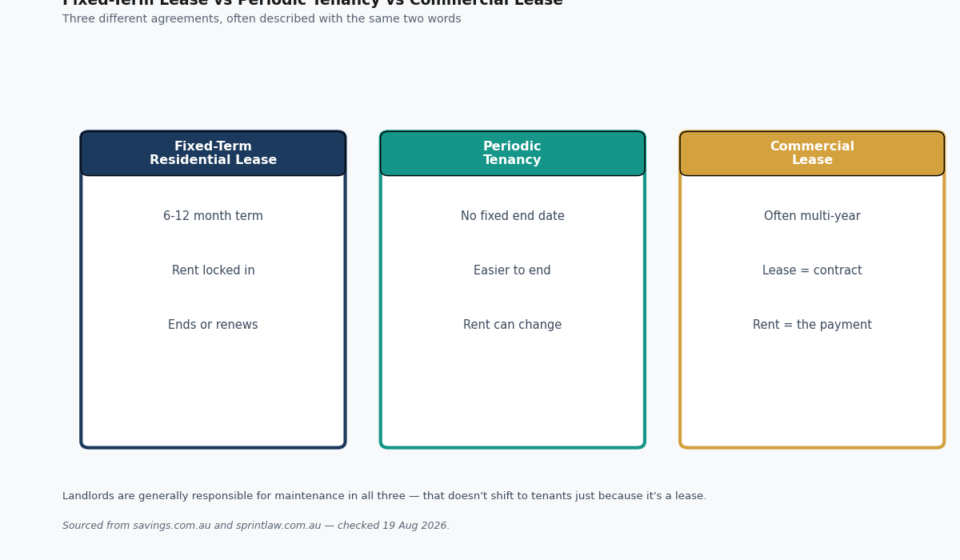
For a house or apartment, a lease is usually the fixed-term agreement you sign, often for six or twelve months. Once that term ends, the arrangement often becomes a periodic tenancy, paid week to week or month to month. People still call that “renting,” even though it’s really what a lease turns into. For a shop or office, the difference is sharper. Lease is the name of the formal contract itself. Rent is the payment you make under it.
What “Lease” and “Rent” Mean for a House or Apartment
- A lease is usually the fixed-term agreement. Most residential leases run six or twelve months, with the rent locked in for that period.
- A periodic tenancy usually follows once the lease ends. Instead of signing a new fixed term, many tenants roll onto a week-to-week or month-to-month arrangement.
- Both are still forms of renting. Whether you’re on a fixed-term lease or a periodic tenancy, you’re renting the property either way.
- Day to day, most people just say “rent.” The word “lease” tends to come up specifically when someone means the signed, fixed-term agreement.
What “Lease” and “Rent” Mean for a Shop or Office
- Lease refers to the contract itself. In commercial property, this is the formal legal document setting out the terms of occupancy.
- Rent refers to the payment. It’s what the tenant pays under that lease, whether weekly, monthly, or another agreed schedule.
- Commercial leases are usually longer and more formal. These agreements often run for several years and can include detailed clauses around fit-outs and renewals.
- The word “renting” is less common in this context. People generally say a business “leases” its premises, even though it still pays rent to do so.
A Straightforward Comparison
- Term length differs. A residential lease often runs six to twelve months. A periodic tenancy has no fixed end date. Commercial leases often run several years.
- Flexibility differs too. A periodic tenancy is easier to end with notice. A fixed-term lease usually locks both sides in until the term is up.
- Rent stability changes across the term. During a fixed-term lease, rent usually can’t go up unless the agreement allows it. Once periodic, rent can change more often. This depends on the state.
- What happens at the end differs by type. A fixed-term lease usually rolls into a periodic tenancy, or gets renewed. A periodic tenancy just keeps going until either side gives notice.
Clearing Up One Common Mistake
- Maintenance responsibility doesn’t shift to the tenant just because it’s called a lease. Under standard Australian tenancy law, landlords are generally responsible for repairs and maintenance, not tenants, regardless of whether the agreement is a fixed-term lease or a periodic tenancy.
- This gets stated incorrectly on some pages. At least one page ranking for this topic claims tenants take on maintenance duties during a lease, which doesn’t match how Australian residential tenancy actually works.
- Always check your specific state’s tenancy rules. The core landlord-responsibility principle holds broadly, but the exact process and timeframes vary state to state.
- A commercial lease can shift more responsibility onto the tenant. This is more common in commercial leases than residential ones, and it depends entirely on what the specific contract says.
FAQ: Difference Between Lease and Rent
Is a lease the same as renting a house?
Close to it. A lease is usually the fixed-term agreement, while renting more broadly covers the whole arrangement, including the periodic tenancy that often follows once the lease ends.
What happens when a fixed-term lease ends?
It commonly rolls into a periodic tenancy, paid week to week or month to month, unless a new fixed-term lease is signed instead.
Is the difference between lease and rent different for commercial property?
Yes. In a commercial setting, lease refers to the formal contract, and rent refers to the payment made under it. The distinction is sharper than it is for housing.
Who’s responsible for maintenance during a lease?
Generally the landlord, under standard Australian residential tenancy law. This applies whether the agreement is a fixed-term lease or a periodic tenancy.
Can my rent increase during a fixed-term lease?
Usually not, unless the lease agreement specifically allows for it. Rent reviews are more common once an agreement becomes periodic, and rules vary by state.
You may also like
 Rent to Buy House Australia: Is It Legal, and Is It Worth It? (2026)
 Renting and Owning in Canada: The Full Picture
 Prenuptial Agreement: The Real Cost, and Why Nobody Knows How Often They Hold Up
 Rent to Own Car: The Real Cost and the Fine Print Nobody Quotes
 Non-Current Liabilities Explained: Examples & How They Work (2026)
 ANZ Fixed Term Deposit Rates: The Full Table and the Notice Period Most Pages Skip
Related posts:
Rent to Buy House Australia: Is It Legal, and Is It Worth It? (2026)
Renting and Owning in Canada: The Full Picture
Prenuptial Agreement: The Real Cost, and Why Nobody Knows How Often They Hold Up
Rent to Own Car: The Real Cost and the Fine Print Nobody Quotes
Non-Current Liabilities Explained: Examples & How They Work (2026)