
Renting and owning both sound simple until you start comparing them. The math gets a lot of attention. What gets skipped is what happens after you decide: what type of property you’d actually own, how co-ownership works if you’re buying with someone else, and what renting really costs once insurance is added in.
Quick Answer: Renting and Owning in Canada
Renting and owning are both financially reasonable choices in Canada, depending on your local rent-to-price ratio, how long you plan to stay, and your down payment. If you buy, you’ll likely choose between a freehold townhouse, where you own the land and building outright, or a condo townhouse, where you pay monthly fees for shared upkeep. If you co-buy, tenants in common lets you split ownership unequally with no automatic transfer to the other owner if you die. If you keep renting, tenant insurance averages $21.74 a month nationally.
Renting vs. Owning: The Real Decision
The rent-vs-buy decision comes down to a simple comparison most calculators already handle well. It’s your monthly rent against a mortgage payment, property tax, and maintenance on a comparable home. It’s also how long you plan to stay before the upfront costs of buying pay off. Renting wins when you might move within a few years. It also wins when rent is genuinely cheap next to home prices in your city. Buying tends to win over a longer stretch, once you pass the breakeven point.
That’s the part every guide covers. What matters just as much is what you’re actually buying into. And what renting costs you beyond just the monthly rent.
What a Freehold Townhouse Actually Means
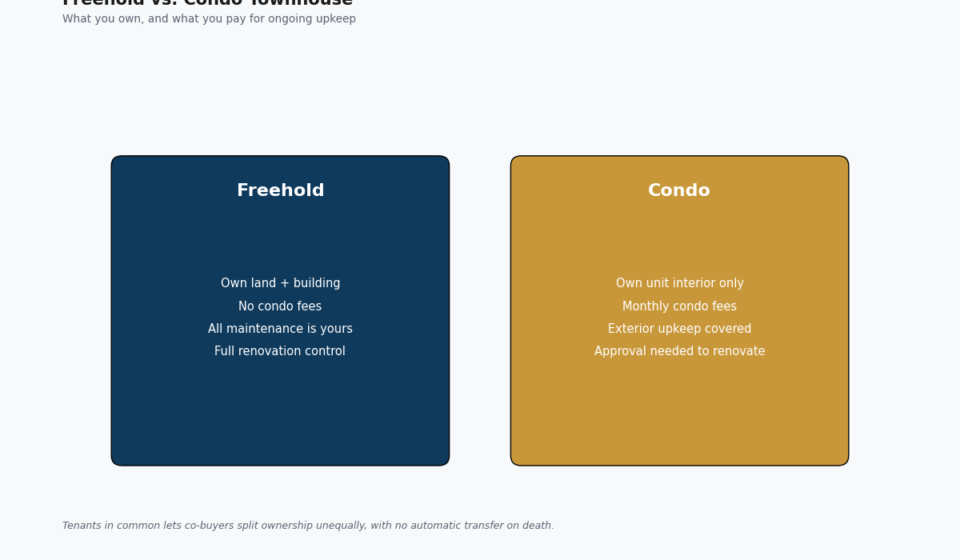
If you decide to buy, you’ll likely run into two very different ownership types. A freehold townhouse means you own the building and the land under it outright. You’re responsible for all maintenance. You pay no condo fees. A condo townhouse means you own the interior of your unit only. The condo corporation handles exterior maintenance and shared amenities. That’s funded by a monthly fee.
Freehold gives you full control and no recurring fees. But it costs more upfront, and every repair falls on you. Condo ownership costs less to buy into, with less personal maintenance. But you’ll pay monthly fees forever, and need approval for bigger renovations.
Tenants in Common: Buying With Someone Else
If you’re buying with a partner, friend, or family member, you’ll likely choose between joint tenancy and tenants in common. Tenants in common lets each owner hold a different share, say 70/30. Both owners still get equal rights to use the whole property. The key difference from joint tenancy shows up when an owner dies. There’s no automatic transfer to the surviving owner. Your share goes through probate instead, and passes according to your will.
This makes tenants in common a common choice for co-owners who aren’t a couple. It also suits people who want to leave their share to someone specific, not automatically to their co-owner. Any owner can sell or transfer their share on their own too, with no permission needed from the others.
What Renting Actually Costs: Tenant Insurance
If you keep renting, tenant insurance is a cost worth budgeting for. The national average runs $21.74 a month, excluding Quebec and Yukon. Provincial averages range from about $19.78 to $23.33. It typically covers three things. Your belongings, against fire and theft. Additional living expenses, if your rental becomes unlivable. And personal liability, if someone gets hurt on your property. Your rate depends on your location, building type, claims history, and how much coverage you choose.
FAQ: Renting and Owning in Canada
Is it better to rent or own in Canada right now?
It depends on your local rent-to-price ratio and how long you plan to stay. Buying tends to make more sense the longer you stay past the breakeven point; renting makes more sense for shorter stays or in cities where rent is cheap relative to home prices.
What’s the difference between a freehold and condo townhouse?
Freehold means you own the land and building outright with no condo fees but full maintenance responsibility. Condo means you own your unit’s interior while the condo corporation handles exterior upkeep, funded by monthly fees.
What does tenants in common mean for co-owners?
Each owner holds a distinct, possibly unequal share of the property, with no automatic transfer to the other owner on death. Your share goes through probate and passes per your will instead.
How much does tenant insurance cost in Canada?
About $21.74 a month on average nationally, covering your belongings, temporary living expenses if your rental becomes uninhabitable, and personal liability.
Can I sell my share if I own a property as tenants in common?
Yes. Each tenant in common can sell, transfer, or bequeath their share independently, without needing agreement from the other owners.
You may also like
 Difference Between Lease and Rent: It Depends Which One You Mean
 Youi Landlord Insurance: What Real Customers Say, Not Just the Marketing
 Rent to Buy House Australia: Is It Legal, and Is It Worth It? (2026)
 Best Used Cars Under $30K in Canada (2026): 10 Reliable Picks
 Rent to Own Car: The Real Cost and the Fine Print Nobody Quotes
 Honda Fit Canada: Why It’s Gone, What It’s Worth in 2026, and What Replaces It
Related posts:
Difference Between Lease and Rent: It Depends Which One You Mean
Youi Landlord Insurance: What Real Customers Say, Not Just the Marketing
Rent to Buy House Australia: Is It Legal, and Is It Worth It? (2026)
Best Used Cars Under $30K in Canada (2026): 10 Reliable Picks
Rent to Own Car: The Real Cost and the Fine Print Nobody Quotes