
Rent to own car deals get pitched on easy approval and no credit check. The real numbers, and one provider’s own fine print on ownership, tell a different story. Here’s what it actually costs and what to check before signing.
Quick Answer: Rent to Own Car
With a rent to own car, you make weekly payments to a provider that owns the vehicle. You don’t own it until every payment is made. In real examples, total costs run well above a normal car loan on the same vehicle, sometimes over $11,000 more. Some providers also state that ownership transfer at the end isn’t guaranteed. It can sit entirely at their discretion, even after you’ve paid in full.
What It Actually Costs
- Weekly payments typically run $100 to $300. The exact figure depends on the vehicle, the provider, and the length of the term.
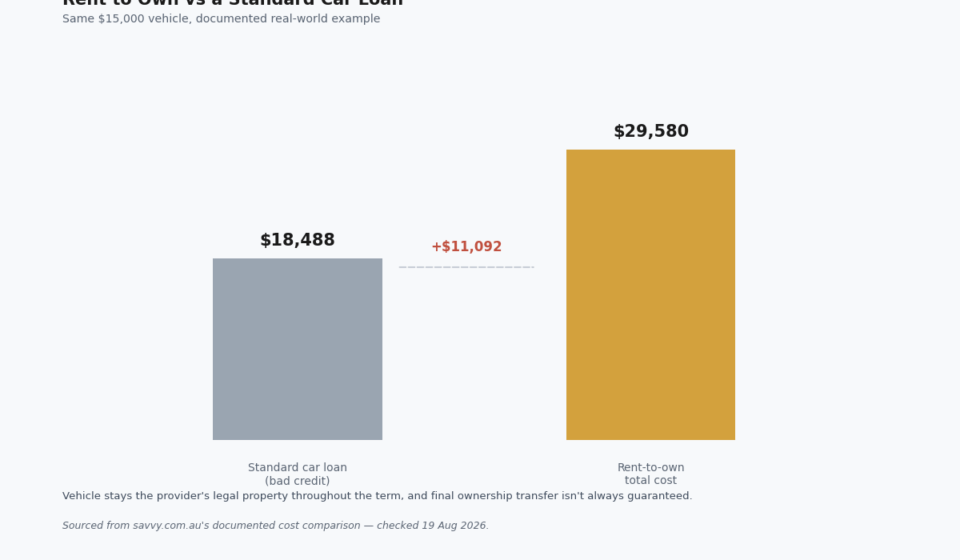
- A real example shows the gap clearly. One documented case: $1,000 upfront plus $180 a week over three years plus a $500 final payment, totalling $29,580 for a $15,000 car.
- That’s far more than a standard loan on the same car. A bad-credit car loan on the same vehicle in that example totalled $18,488, over $11,000 less than the rent-to-own total.
- Extra fees add up fast. Late fees, account-keeping fees, and early termination charges can push the real cost higher again.
The Ownership Catch Few Pages Mention
- You don’t own the car during the term. The provider stays the legal owner the whole time you’re paying.
- Some providers make final transfer discretionary. One live provider’s own terms state that ownership transfer at the end is “subject to sole discretion and approval” and “not guaranteed.”
- That means paying in full doesn’t automatically mean owning the car. It’s worth getting this specific clause in writing and asking directly before signing anything.
- Marketing rarely leads with this detail. Ads tend to focus on low weekly payments and easy approval instead.
What Happens If You Miss a Payment
- Vehicles can be repossessed for missed payments. Rent to own agreements generally give the provider this right, similar to other secured car finance.
- You can still owe money after repossession. This is a known risk pattern in car finance broadly. Regulators have found many borrowers still owe over half their loan even after their car is taken back.
- Some vehicles include remote immobilisers. These can disable the car if a payment is missed, before repossession even happens.
- Missed payments can affect your credit file. The impact varies by provider, so it’s worth asking directly how missed payments get reported.
What to Check Before You Sign
- Ask for the total cost in writing, not just the weekly figure. Add up every payment across the full term, plus any deposit and final payment, before comparing it to a normal loan.
- Get the ownership transfer terms in writing. Confirm exactly what happens at the end of the term, and whether transfer is guaranteed or discretionary.
- Compare against an actual car loan quote. Even a bad-credit loan can come out significantly cheaper, as real cost comparisons have shown.
- Ask what triggers repossession and what you’d still owe. Get a clear answer on missed-payment consequences before you commit to weekly payments.
FAQ: Rent to Own Car
How does rent to own work for a car?
You make regular payments to a provider that keeps legal ownership of the car throughout the term. Only once every payment is made do you become eligible for ownership transfer.
Is rent to own more expensive than a car loan?
Often, yes, and sometimes by a large margin. One documented comparison showed a rent-to-own total over $11,000 higher than a bad-credit car loan on the same vehicle.
Do I definitely own the car at the end of a rent-to-own agreement?
Not always. Some providers state that ownership transfer is discretionary and not guaranteed, even after every payment is made. Always confirm this in writing.
What happens if I miss a rent-to-own payment?
The provider can generally repossess the vehicle. You may still owe money afterward, and some vehicles include remote immobilisers that can disable the car before repossession.
Do rent-to-own providers check my credit?
Many advertise no credit checks, which is part of the appeal for buyers who can’t get approved for a standard loan. That easier approval is a major reason the overall cost tends to run higher.
You may also like
 Rent to Buy House Australia: Is It Legal, and Is It Worth It? (2026)
 Bad Credit Car Loans Australia: The Real Rate Range and What Actually Helps
 Bad Credit Loans in Canada: The Real Rates You’ll Pay
 Car Stamp Duty WA Calculator: The Full Rate Table (2026)
 Difference Between Lease and Rent: It Depends Which One You Mean
 How Much Does It Cost to Tow a Car? Real US Prices
Related posts:
Bad Credit Car Loans Australia: The Real Rate Range and What Actually Helps
Rent to Buy House Australia: Is It Legal, and Is It Worth It? (2026)
Bad Credit Loans in Canada: The Real Rates You’ll Pay
Car Stamp Duty WA Calculator: The Full Rate Table (2026)
Difference Between Lease and Rent: It Depends Which One You Mean