
Kids savings account interest rates change more often than most parents realise, and some “best of” lists haven’t caught up. One still-ranking 2024 page currently overstates a top pick’s rate by 75 basis points. Here’s the real, current top-rate table, and how to spot when a comparison page you’re reading has gone stale.
Quick Answer: Kids Savings Account Interest Rates Right Now
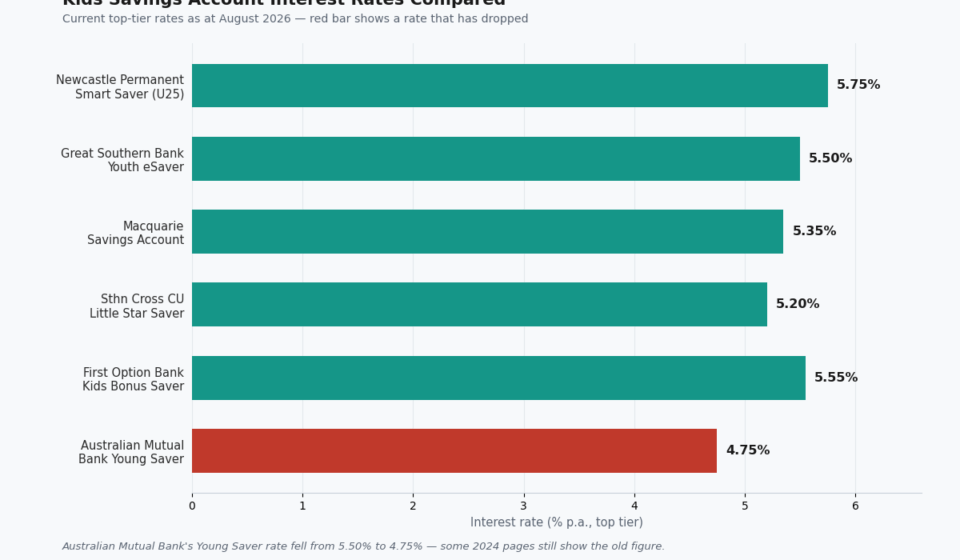
As at August 2026, the highest kids savings account rates come from Great Southern Bank’s Youth eSaver. It pays up to 5.50% per annum for ages 0-17, on balances up to $5,000. Macquarie’s Savings Account pays a 5.35% welcome rate for four months, for age 12 and up, on balances up to $250,000. Southern Cross Credit Union’s Little Star Saver pays 5.20% for ages 0-14. Australian Mutual Bank’s Young Saver is still shown at “up to 5.50%” on some older comparison pages. It has actually dropped to 4.75% per annum. Always check the account’s age range and balance cap before assuming a rate applies to your child.
Current Kids Savings Account Interest Rates Compared
| Account | Rate (p.a.) | Age range | Balance cap for top rate |
|---|---|---|---|
| Great Southern Bank Youth eSaver | Up to 5.50% | 0-17 | Up to $5,000 |
| Newcastle Permanent Smart Saver (Under 25s) | Up to 5.75% | Under 25 | Tiered by balance |
| Macquarie Savings Account | 5.35% (welcome rate, 4 months) | 12+ | Up to $250,000 |
| First Option Bank Kids Bonus Saver | 4.80-5.55%, conditions apply | Varies | Monthly deposit/no-withdrawal conditions |
| Southern Cross Credit Union Little Star Saver | 5.20% | 0-14 | Up to $50,000, no withdrawals |
| Australian Mutual Bank Young Saver | 4.75% (down from 5.50%) | Varies | See note below |
Rates and conditions change often. Bonus rates usually require a minimum monthly deposit and no withdrawals that month. Read the fine print before opening an account based on a headline number.
The Rate That Dropped: Australian Mutual Bank Young Saver
A Mozo page from 9 May 2024, still indexed and appearing in search results, lists the Australian Mutual Bank Young Saver account at “up to 5.50% per annum” for balances under $5,000. That’s no longer accurate. Finder’s rate table, last updated 14 July 2026, shows the same account’s maximum rate at 4.75% per annum. That’s a 75-basis-point drop on a balance of $5,000. It’s worth roughly $37.50 a year in lost interest at the old rate versus the new one.
This isn’t a case of the account closing or changing name. It’s the same product. The rate moved down while an old comparison page kept ranking. If you’re choosing between accounts based on a “best of” list, check the date on that list first.
Watch for Mismatched Freshness Dates
Not every stale page is obviously stale. One comparison site’s kids savings account page carries a headline referencing “August 2026” rates, but its own byline reads “Updated 13 Apr 2023.” That’s a genuine gap between what the page claims and when it was actually checked. It’s a useful habit for any rate comparison, not just this one. Look past the headline date. Find the actual last-updated byline before trusting a rate table.
How to Choose the Right Account for Your Child’s Age
Most kids savings accounts fall into two brackets. Accounts for younger children (roughly 0-14) tend to have lower balance caps and simpler bonus conditions, often just “no withdrawals this month.” Accounts aimed at teens and young adults, roughly 12 or 16 through 24-25, usually allow higher balances. Some pair with a linked debit card for pocket money and part-time work income.
Check three things before opening any account. First, the age range it actually covers. Second, whether the advertised rate needs a monthly deposit or no-withdrawal condition. Third, the balance tier where the bonus rate stops. A 5.50% headline rate that only applies to the first $5,000 is a different product than a flat 5.50% on any balance.
Is Interest on a Kids Savings Account Taxed?
Yes, in most cases. Interest earned in a child’s name is generally treated as the child’s income for tax purposes. Different rules apply depending on who controls the account and where the money came from. If the funds effectively belong to a parent, for example if deposits are the parent’s own savings kept in the child’s name, the Australian Taxation Office can treat that interest as the parent’s income instead. This is genuinely worth checking against your own situation. It’s not something a comparison table can settle for you.
FAQ: Kids Savings Account Interest Rates
What is the best kids savings account rate in Australia right now?
As at August 2026, Great Southern Bank’s Youth eSaver and Newcastle Permanent’s Smart Saver for under-25s are among the highest. Both offer rates above 5.5% for eligible balances and age ranges.
Has any kids savings account rate recently dropped?
Yes. Australian Mutual Bank’s Young Saver account has fallen from 5.50% per annum to 4.75% per annum. At least one still-ranking 2024 comparison page hasn’t been updated to reflect this.
Is interest earned in a kids savings account taxed?
Generally yes, as the child’s income, though the ATO can treat it as a parent’s income if the funds effectively belong to the parent. Check your specific situation.
How do I know if a comparison page’s kids savings account rates are current?
Check the actual “last updated” byline, not just the page’s headline or title, which can reference the current month without the content having been rechecked.
Do kids savings accounts have balance limits for the bonus rate?
Often, yes. Many top rates only apply up to a set balance, such as $5,000 or $50,000, with a lower rate on anything above that.
You may also like
 Bankwest Savings Interest Rates: Easy Saver vs Hero Saver Explained
 Age Grade Calculator
 Best Savings Accounts UK: Top Rates Compared (2026)
 UBank Interest Rates: The Intro Rate vs the Rate You’ll Actually Keep
 St George Term Deposit Rates: The Full Table, Verified Against Three Conflicting Sources
 Bankwest Retirement Advantage Account: The Real Rate Tiers (One Review Gets Them Wrong)
Related posts:
Bankwest Savings Interest Rates: Easy Saver vs Hero Saver Explained
Best Savings Accounts UK: Top Rates Compared (2026)
UBank Interest Rates: The Intro Rate vs the Rate You’ll Actually Keep
Bankwest Retirement Advantage Account: The Real Rate Tiers (One Review Gets Them Wrong)
St George Term Deposit Rates: The Full Table, Verified Against Three Conflicting Sources