
Caravan finance ads lead with their lowest possible rate. Most borrowers pay more than that. Here’s the realistic rate range, the van age rule that catches people out, and how balloon payments actually work.
Quick Answer: Caravan Finance
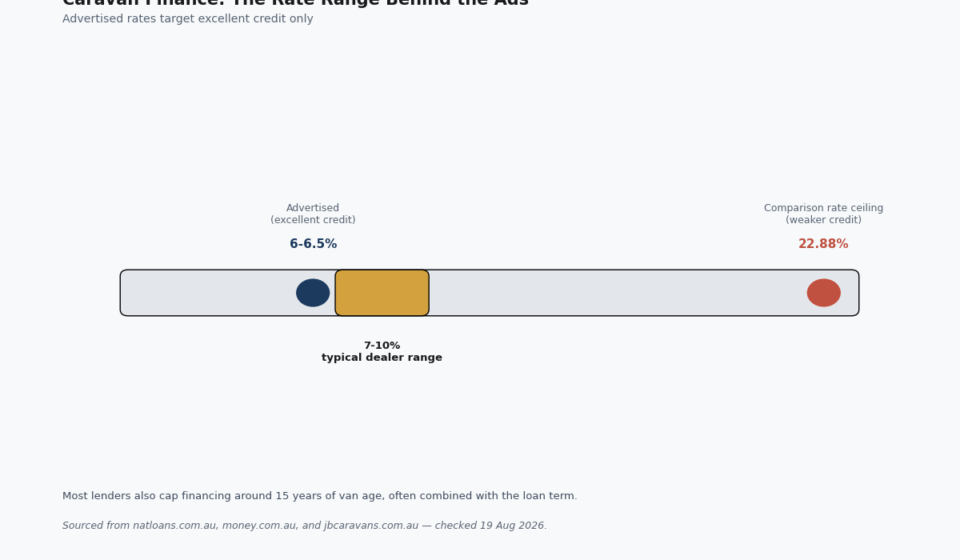
Caravan finance splits into secured loans, where the van itself is collateral, and unsecured personal loans, which don’t use the van as security. Advertised rates start around 6% to 6.5% for borrowers with strong credit. But comparison rates, which better reflect the real cost, range up to around 22.88% for weaker credit profiles. Most lenders also won’t finance a caravan older than about 15 years, and there’s often a combined limit on the van’s age plus your loan term together.
The Realistic Rate Range
- Advertised rates start around 6% to 6.5% per annum. That’s the figure lenders lead with, aimed at borrowers with excellent credit.
- Comparison rates tell a fuller story. These bundle in standard fees and can range from around 6.99% up to 22.88%, depending on your credit profile.
- Dealers often see a more typical range of 7% to 10%. This reflects what actually gets approved for most borrowers, not just the best-case scenario.
- Your credit profile drives most of the gap. A strong credit history and stable income can get you close to the advertised rate. A thinner file usually means something well above it.
Secured vs Unsecured Caravan Loans
- Secured loans use the caravan as collateral. This generally means a lower rate and access to higher loan amounts, since the lender has an asset to fall back on.
- Unsecured loans don’t tie the loan to the van. These are standard personal loans, usually at a higher rate, since the lender is relying purely on your credit profile.
- A worked example shows the real cost difference. A $120,000 van financed at 8.5% over 7 years, with a $15,000 deposit, runs to roughly $1,665 a month.
- A shorter term can save a lot in total interest. The same loan over 5 years instead of 10 can save around $19,400 in interest, despite the higher monthly repayment.
The Van Age Rule Most Pages Skip
- Most lenders won’t finance a caravan older than about 15 years. This limit varies by lender, but it’s a common cutoff worth checking early.
- Age and loan term often combine into one limit. A 12-year-old van paired with a 5-year loan can push past a lender’s combined threshold, even if each figure alone looks fine.
- This catches out buyers of older or secondhand vans. It’s worth confirming eligibility before you fall in love with a specific caravan.
- Newer vans generally have more finance options open to them. If you’re weighing a slightly older van against a newer one, financing eligibility is worth factoring into that decision.
How Balloon Payments Actually Work
- A balloon payment lowers your regular repayments. In exchange, a lump sum stays owing at the end of the loan term instead of being paid off gradually.
- That lump sum doesn’t disappear. You’ll need to pay it out, refinance it, or sell the van to cover it when the term ends.
- Not every lender explains this clearly upfront. Some finance pages mention balloon payments only in passing, without spelling out what you’d owe at the end.
- Ask for the exact balloon figure before signing. Get it in writing, in dollars, not just as a percentage of the loan.
FAQ: Caravan Finance
What interest rate can I expect on caravan finance?
Advertised rates start around 6% to 6.5% for strong credit profiles. Comparison rates, which reflect the fuller cost, range up to about 22.88% depending on your credit history.
Is caravan finance secured or unsecured?
Both options exist. Secured loans use the caravan as collateral and generally offer lower rates. Unsecured personal loans don’t tie the loan to the van, but usually cost more.
Can I finance an older caravan?
Often, yes, but most lenders cap financing at around 15 years of age, and some apply a combined age-plus-loan-term limit. Check this before choosing a specific van.
What is a balloon payment on a caravan loan?
It’s a lump sum that stays owing at the end of your loan term, in exchange for lower regular repayments along the way. You’ll need to pay it out, refinance it, or sell the van to cover it.
How much does a typical caravan loan cost per month?
It depends heavily on the loan amount, rate, deposit, and term. As one example, a $120,000 van at 8.5% over 7 years, with a $15,000 deposit, runs to roughly $1,665 a month.
You may also like
 Motorbike Loans: What Rate You’ll Realistically Get (2026)
 Line of Credit: The Three Types Explained in One Place
 Bad Credit Car Loans Australia: The Real Rate Range and What Actually Helps
 Age Grade Calculator
 Bad Credit Loans in Canada: The Real Rates You’ll Pay
 Home Loan Interest Rates Australia: What’s on Offer Now (2026)
Related posts:
Motorbike Loans: What Rate You’ll Realistically Get (2026)
Line of Credit: The Three Types Explained in One Place
Bad Credit Car Loans Australia: The Real Rate Range and What Actually Helps
Bad Credit Loans in Canada: The Real Rates You’ll Pay
Home Loan Interest Rates Australia: What’s on Offer Now (2026)