
Cheques still work in Australia today. They just won’t forever. Here’s how to write a cheque in Australia correctly, plus the confirmed government dates for when cheques stop being issued and, eventually, stop being accepted at all.
Quick Answer: How to Write a Cheque in Australia
Fill in the date, the payee’s full name, the amount in both words and figures, and your signature. Double-check the name and amount match exactly. Banks reject cheques with mismatches. Cheques remain fully valid in Australia right now. The government has confirmed a two-step phase-out. Banks will stop issuing new cheques from 30 June 2028. Cheques will stop being accepted entirely from 30 September 2029. If you’re writing or depositing one today, there’s nothing to worry about. You’re years ahead of the cutoff.
Steps for How to Write a Cheque in Australia
- Write the date in the top-right corner. Use the day you’re writing the cheque.
- Write the payee’s name on the “Pay” line. Use the person or business’s full, correct name. Banks match this exactly.
- Write the amount in words on the line below the payee’s name (for example, “Two hundred and fifty dollars only”). Start close to the left edge. Draw a line through any empty space to prevent alterations.
- Write the amount in figures in the small box, usually on the right (for example, “$250.00”). This figure must match the written amount exactly.
- Sign the cheque in the bottom-right corner. Match the signature your bank holds on file.
- Cross the cheque if you want it paid only into a bank account, not cashed over the counter. Draw two parallel lines across the top-left corner to do this. Add “Account Payee Only” between the lines for extra security.
Keep a record of the cheque number, date, payee, and amount. Use your chequebook stub or a separate note. You may need it later if you query or stop the payment.
Depositing a Cheque in Australia
Most Australian banks let you deposit a cheque through their mobile app. Just photograph the front and back, rather than visiting a branch. Cheques typically take three working days to clear before the funds become fully available. Sometimes the payer’s account lacks sufficient funds and the cheque bounces. When that happens, the bank can reverse the deposit after it initially appears to clear. Treat a freshly deposited cheque with some caution before you spend against it.
When Cheques Are Being Phased Out in Australia
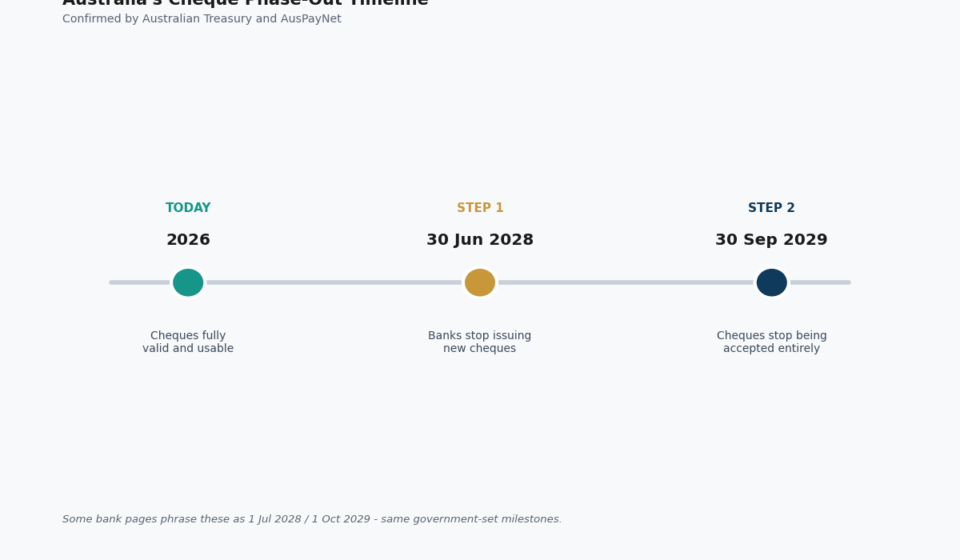
The government confirmed a two-step timeline for winding down the cheque system. Treasury set this out in its official Cheques Transition Plan:
- From 30 June 2028: Banks stop issuing new personal, commercial, government, and bank cheques.
- From 30 September 2029: Banks stop accepting cheques altogether, and the cheque clearing system closes.
Some bank pages describe these same dates slightly differently. Westpac, for example, refers to “1 July 2028” and “1 October 2029” for its own customer-facing deadlines. Both descriptions point to the same government-set milestones. The small difference just reflects how each bank frames its internal cutover.
The transition plan followed the 2023 Strategic Plan for Australia’s Payments System. It received Australian Competition and Consumer Commission authorisation in July 2025, clearing the way for banks to coordinate the wind-down together. Cheques now make up less than 0.1% of retail payments in Australia. That decline is the core reason behind the shift toward digital alternatives like PayID, PayTo, BPAY, and direct bank transfers.
What This Means If You Still Use Cheques
If you write or receive cheques now, nothing changes immediately. You have until mid-2028 before new cheques stop being issued. You have until late 2029 before deposited cheques stop being accepted at all. Banks are actively helping customers move to alternatives like PayID and PayTo well ahead of the deadlines. This especially helps older Australians and those without reliable internet access. If cheques are your main way of paying bills or receiving payments, explore one of these alternatives soon. Don’t wait until the cutoff approaches.
FAQ: How to Write a Cheque in Australia
How do you fill out a cheque correctly in Australia?
Write the date, the payee’s full name, the amount in both words and figures, and sign it to match your bank’s records on file.
Are cheques still valid in Australia in 2026?
Yes, cheques remain fully valid and usable. The phase-out doesn’t begin restricting issuance until 30 June 2028.
When will cheques stop working in Australia?
Banks stop issuing new cheques from 30 June 2028. Cheques stop being accepted entirely from 30 September 2029.
How long does a cheque take to clear in Australia?
Typically three working days, though the deposit can still be reversed after that if the payer’s account lacks sufficient funds.
What should I use instead of cheques?
PayID, PayTo, BPAY, and standard bank transfers are the main alternatives banks are encouraging customers to move to ahead of the phase-out.
You may also like

Related posts:
 How to Read a Cheque in Canada: Every Field Explained
 Is It Safe to Buy a Repaired Write Off? The State-by-State Answer (2026)
 Open Bank Account Online Australia: The Real Timeline
 Judo Bank Term Deposit Rates: The Full Table and Why It’s Shaped This Way
 Adelaide Bank Term Deposit Rates: Why Its Own Site Doesn’t Show Them