
PPOR stands for Principal Place of Residence, and it’s the one property you can own that’s generally exempt from capital gains tax. You can only have one at a time, and getting the label wrong can cost you thousands. Here’s the plain definition, then exactly what qualifies.
Quick Answer: PPOR
PPOR means Principal Place of Residence, though some sources also call it Primary Place of Residency. It’s simply the main home you live in, as opposed to an investment property or a holiday house. Only one property can count as your PPOR at any given time. The main benefit is tax: selling your PPOR is usually exempt from capital gains tax, and most states also waive land tax on it. Living there genuinely, not just planning to, is what makes a property count.
1. What Actually Makes a Property Your PPOR
- Genuine occupation matters, not just intention. So you need to actually live there, since simply planning to move in one day doesn’t qualify a property as your main home.
- Only one property counts at a time. Because the ATO only recognises a single main residence per person, even if you own several properties.
- Your address on record needs to match. So mail, your driver’s licence, and electoral roll details all help confirm which property is genuinely your home.
- Utilities being connected helps too. Since active power, water, and internet accounts at the address support the case that you actually live there.
2. The Tax Benefit That Makes PPOR Worth Knowing
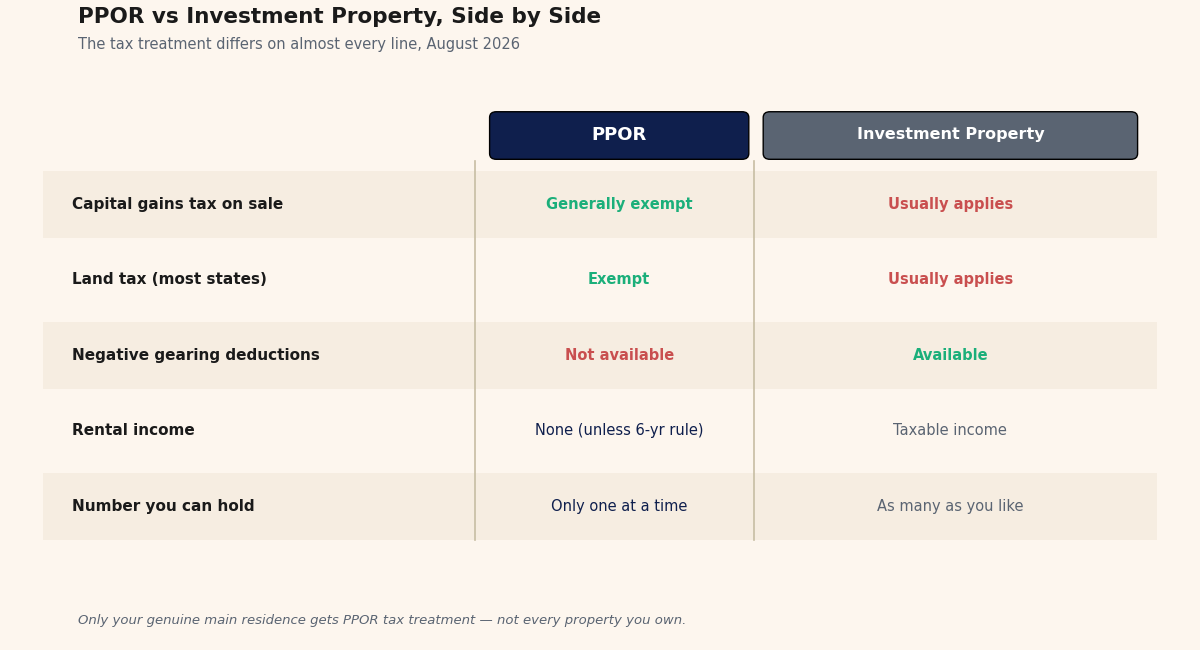
- Capital gains tax usually doesn’t apply. So when you sell it, any profit is generally exempt from CGT, unlike an investment property.
- Land tax gets waived in most states. Because your main home is typically excluded from land tax, while investment properties usually aren’t.
- The savings can run into the tens of thousands. So on a large capital gain, the CGT exemption alone can be worth a substantial amount.
- None of this applies automatically to a second property. Since only your genuine main residence gets these exemptions, not every property you happen to own.
3. The 6-Year Rule, in Plain Terms
- You can rent out your main home and keep the exemption. So moving out and renting the property doesn’t automatically end its exempt status.
- The clock runs for up to 6 years. Because the exemption keeps applying for that period, as long as you don’t treat another property as your main residence instead.
- Moving back in resets the clock. So living there again before the 6 years ends lets you restart a fresh 6-year period once you move out again.
- This rule helps people who relocate for work. Since it protects the exemption for someone who has to move away temporarily but plans to return.
4. Common Mistakes That Cost People Money
- Claiming two properties as PPOR at once. So couples who each already owned a home before moving in together need to choose just one, not keep both exempt.
- Forgetting to update your address details. Because outdated mail or licence records can weaken your case if the ATO later questions your PPOR claim.
- Assuming a holiday home counts. So a property you only visit occasionally, without genuinely living there, doesn’t meet the standard, no matter how often you use it.
- Not tracking the 6-year clock. Since losing track of how long a former home has been rented out can mean an unexpected CGT bill down the line.
For related reading, see our guides to Sunset Clause: The Real Risk in 2026, State by State and Stamp Duty on Inherited Property NSW: The Real Rules (2026).
FAQ: PPOR
What does PPOR stand for?
Principal Place of Residence. It’s the main home you genuinely live in, as opposed to an investment property or a holiday house.
Can I have more than one PPOR?
No. Only one property can count as your PPOR at any given time, even if you own several properties.
Is my PPOR exempt from capital gains tax?
Generally, yes. Selling your genuine main residence is usually exempt from CGT, while an investment property normally isn’t.
What is the 6-year rule for a PPOR?
It lets you rent out your former PPOR for up to 6 years and still keep the CGT exemption, as long as you don’t claim another property as your main residence during that time.
Do I pay land tax on my PPOR?
In most states, no. Your main home is typically exempt from land tax, unlike most investment properties.
You may also like
 First Home Buyer Stamp Duty Exemption Threshold (2026)
 Stamp Duty on Inherited Property NSW: The Real Rules (2026)
 Australian Property Investor Tax Deadline: The 2026 Date
 What Is Negative Gearing in Australia? (2027 Reform Explained)
 Investment Property Calculator: Cash Flow vs the Taxable Result
 Sunset Clause: The Real Risk in 2026, State by State
Related posts: