
P&N Bank term deposit rates don’t climb steadily with term length. Some shorter terms actually beat longer ones. Here’s the real current rate table, and which term actually pays the most right now.
Quick Answer: P&N Bank Term Deposit Rates
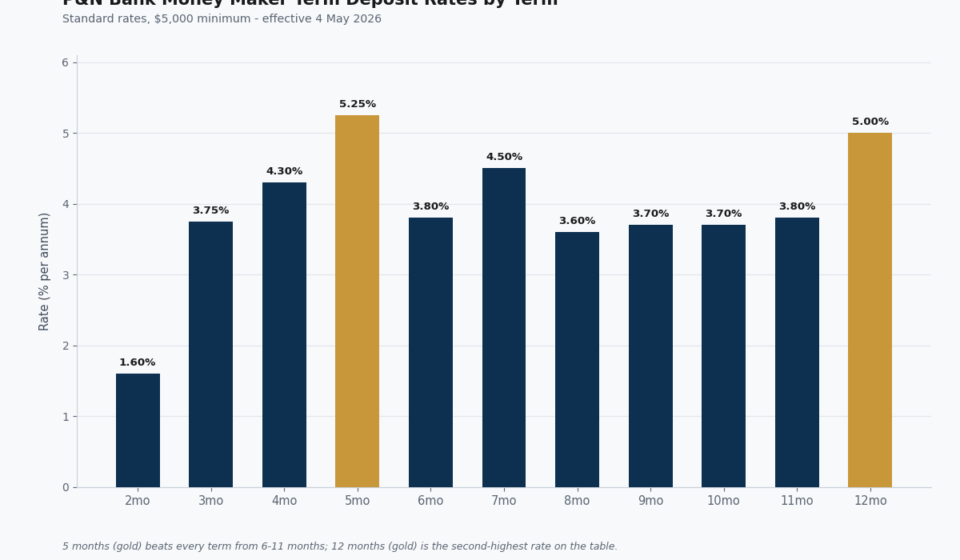
P&N Bank term deposit rates run from 1.60% to 5.25% p.a., depending on the term. The 5-month special sits at 5.25%. That’s higher than 6, 7, 8, 9, 10, and 11-month terms. The 12-month term comes back up to 5.00%. It’s not a smooth climb. P&N Bank is a Perth-based, member-owned mutual bank. It’s not a subsidiary of a larger bank. Rates are effective from 4 May 2026 and can change at any time. The minimum deposit for most terms is $5,000.
The Real Current Rate Table
- Short terms swing a lot. 2 months sits at 1.60%. 3 months jumps to 3.75%. 4 months climbs further to 4.30%.
- 5 months is the standout. At 5.25%, it beats every term from 6 to 11 months.
- Mid terms dip back down. 6 months sits at 3.80%. 7 months rises to 4.50%. 8 through 11 months sit between 3.60% and 3.80%.
- 12 months climbs back up to 5.00%. This is the second-highest rate on the whole table, just below the 5-month special.
Why the Rates Don’t Climb Smoothly
- These are called “special” rates for a reason. Banks often set promotional rates on specific terms to attract deposits at points that suit their own funding needs.
- This isn’t unique to P&N Bank. Similar non-monotonic patterns show up across other banks in this series, so don’t assume any bank’s longest term automatically pays the most.
- Always check the whole table, not just the headline rate. A “5.25% p.a.” heading could apply to a term you weren’t even considering.
- Rates can change at any time. P&N Bank states rates may shift between application and account opening, so confirm before you commit.
Three Different Term Deposit Products
- Money Maker is the main product. This is the table above, running from 2 to 12 months with the non-monotonic rate structure.
- P&N Retirement Term Deposit is separate. It offers a flat 3.85% for a 3-month term, aimed at retirement savers specifically.
- Regular Income Term Deposit pays out differently. It offers 4.20% for 12-35 months, or 3.35% for 36-60 months, with monthly, quarterly, or annual payment options.
- Check which product fits your goal. Money Maker suits a lump sum you want locked away. Regular Income suits someone who wants ongoing payouts.
What Kind of Bank Is P&N Bank?
- It’s a member-owned mutual, not a subsidiary. P&N Bank isn’t owned by a larger bank the way some smaller brands are.
- It’s based in Perth, Western Australia. Its roots and branch network sit mainly in WA.
- Being a mutual changes the governance model. Profits and structure work differently than at a shareholder-owned bank, which some savers specifically prefer.
- This doesn’t change deposit protection. Like other authorised deposit-taking institutions, P&N Bank deposits are covered by the same government guarantee scheme up to the standard limit.
FAQ: P&N Bank Term Deposit Rates
What is P&N Bank’s highest term deposit rate?
The 5-month special sits at 5.25% p.a., the highest rate on the Money Maker table, just ahead of the 12-month rate at 5.00%.
Do P&N Bank’s term deposit rates increase with longer terms?
No. Several mid-length terms (6-11 months) sit below both the 5-month and 12-month specials. Check the full table rather than assuming a steady climb.
What is the minimum deposit for a P&N Bank term deposit?
$5,000 for the Money Maker and Retirement products.
Is P&N Bank a subsidiary of a larger bank?
No. It’s a member-owned mutual bank based in Perth, not owned by a larger banking group.
What’s the difference between P&N Bank’s three term deposit products?
Money Maker is the standard lump-sum product. Retirement offers a flat rate for retirement savers. Regular Income pays out periodically over 12-60 months.
You may also like
 Judo Bank Term Deposit Rates: The Full Table and Why It’s Shaped This Way
 Macquarie Bank Term Deposit Rates: Two Products, Two Different Tables
 Great Southern Bank Term Deposit Rates: Standard vs Platinum Plus
 ANZ Fixed Term Deposit Rates: The Full Table and the Notice Period Most Pages Skip
 ME Bank Term Deposit Rates: The Real Table (One Comparison Site Shows None)
 St George Term Deposit Rates: The Full Table, Verified Against Three Conflicting Sources
Related posts:
Judo Bank Term Deposit Rates: The Full Table and Why It’s Shaped This Way
Macquarie Bank Term Deposit Rates: Two Products, Two Different Tables
Great Southern Bank Term Deposit Rates: Standard vs Platinum Plus
ANZ Fixed Term Deposit Rates: The Full Table and the Notice Period Most Pages Skip
ME Bank Term Deposit Rates: The Real Table (One Comparison Site Shows None)