The digital marketing ecosystem in the United States is currently undergoing its most significant transformation since the invention of the smartphone. As we move through 2026 and look toward 2027, the industry has moved beyond the “hype” phase of Artificial Intelligence and into a period of deep structural integration. For businesses, developers, and creators, understanding this shift isn’t just about staying relevant—it’s about survival in a market that is increasingly automated, privacy-centric, and fragmented across new media formats.
1. The Death of Traditional SEO and the Birth of GEO
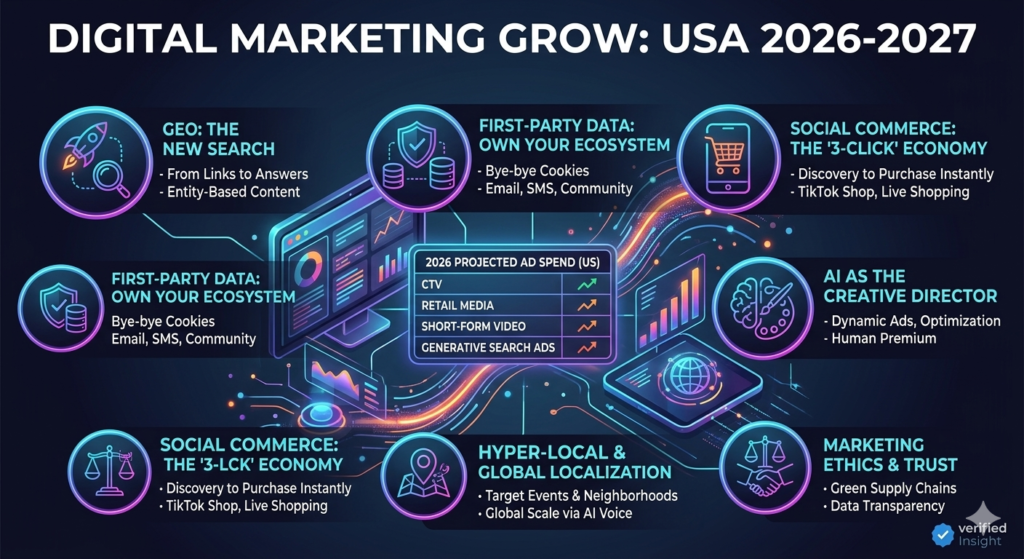
For over two decades, Search Engine Optimization (SEO) was the king of digital growth. You optimized for keywords, built backlinks, and hoped Google’s crawler ranked you #1. In 2026, that model has been disrupted by Generative Engine Optimization (GEO).
With the rise of Answer Engines like OpenAI’s SearchGPT and Google’s Gemini-integrated search, users are no longer clicking through a list of blue links. They are receiving direct, conversational answers.
- The Strategy Shift: Marketers are now focused on “Source Credibility.” To show up in an AI’s answer, your content must be cited as a trusted authority. This means moving away from “keyword stuffing” and toward “entity-based” content that answers complex, multi-layered questions.
- Visual and Voice Integration: By 2027, over 50% of searches in the USA are expected to be non-text-based, utilizing visual searches (like Google Lens) and advanced voice assistants that understand context and intent better than ever before.
2. The Rise of “Small Data” and First-Party Ownership
The “Cookie-less” world is no longer a future threat—it is the current reality. With third-party tracking severely limited by privacy laws and OS-level blocks, the most valuable asset a business can own in 2026 is First-Party Data.
Successful brands are shifting their budgets away from mass-market programmatic ads and toward building “owned” ecosystems.
- Email and SMS 2.0: These aren’t just for newsletters anymore. They are used for hyper-personalized “flows” triggered by specific user actions.
- Community as a Moat: Brands are building private communities (on platforms like Discord, Slack, or proprietary apps) to gather deep insights directly from their customers. This “Zero-Party Data”—information users voluntarily share—is the fuel for AI-driven personalization that actually feels helpful rather than creepy.
3. Social Commerce: The “Three-Click” Economy
In the USA, the gap between “seeing an ad” and “owning the product” has virtually disappeared. Social commerce, led by platforms like TikTok Shop and Instagram’s integrated checkout, has turned social media into a digital mall.
The “Three-Click Rule” is the new benchmark: if a user cannot discover, vet, and purchase a product within three taps, the conversion rate drops by over 60%.
- Creator-Led Growth: The era of the “Mega-Influencer” is fading. Brands are now seeing much higher ROI from “Subject Matter Experts” (SMEs)—creators who may only have 50,000 followers but possess deep trust in specific niches like fintech, app development, or sustainable living.
- Live Stream Shopping: Once exclusive to the Chinese market, live shopping has officially gone mainstream in the USA. It combines entertainment with urgency, creating a “Fear Of Missing Out” (FOMO) that traditional e-commerce cannot replicate.
4. AI as the “Creative Director”
By 2027, the role of the digital marketer has shifted from “execution” to “curation.” AI tools now handle the heavy lifting of A/B testing, copy generation, and video editing.
- Dynamic Creative Optimization (DCO): Ads are no longer static. An ad shown to a 25-year-old developer in San Francisco will have different colors, music, and messaging than the same ad shown to a 40-year-old manager in Chicago—generated in real-time by AI to maximize resonance.
- The “Human” Premium: As the internet becomes flooded with AI-generated content, there is a growing “Human Premium.” Content that shows a unique personality, controversial take, or real-world experience is gaining more traction because it cannot be easily synthesized.
The Projected Spend: Where the Money is Going
| Channel | 2026 Forecast (US Market) | Key Growth Driver |
| Connected TV (CTV) | $36 Billion | Cord-cutting & Interactive Ads |
| Retail Media Networks | $60 Billion | Ads inside Amazon/Walmart apps |
| Short-Form Video | $45 Billion | TikTok & YouTube Shorts dominance |
| Generative Search Ads | $15 Billion | AI-integrated search placements |
5. Hyper-Local Targeting and Global Scaling
Despite the global nature of the internet, 2026 sees a massive return to Hyper-Local Marketing. Digital ads are now precise enough to target specific neighborhoods or even specific events (like a tech conference or a cricket match) with extreme accuracy.
At the same time, scaling to international markets (like the South Asian corridor) has become easier through AI-powered localization. A brand based in the USA can now localize its entire video ad campaign into Hindi or Urdu with perfect lip-syncing and cultural nuance using “Digital Twin” technology.
6. The Ethics of Marketing in 2027
As technology advances, consumers are becoming more sensitive to the ethical implications of the brands they support.
- Sustainability Branding: It’s no longer enough to have a good product; brands must prove their “green” credentials through transparent supply chains.
- Data Transparency: Companies that are open about how they use AI and data are seeing higher brand loyalty scores. In 2027, “Trust” is the most expensive currency in the digital market.
Conclusion: Staying Ahead of the Curve
The digital marketing landscape of 2026-2027 is a high-speed environment where the only constant is change. To win, businesses must move away from broad, generic strategies and embrace a “Niche-Down, Tech-Up” philosophy.
By leveraging AI for operational efficiency while doubling down on human-centric storytelling and first-party data, marketers can navigate this complex era successfully. The future belongs to those who can balance the cold precision of an algorithm with the warmth of a genuine human connection.